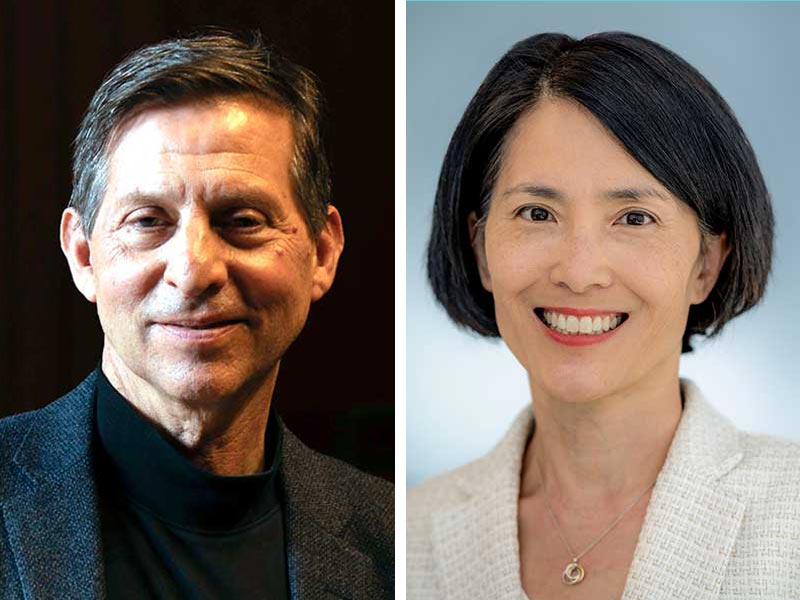
The Opening Plenary “Precision, Partnership, Purpose: Advancing Cancer Science to Save Lives Globally” will exemplify the breadth and overarching theme of the AACR Annual Meeting 2026 with presentations on topics that have the potential to transform the future of cancer research and patient care, noted Annual Meeting Program Chairs Paul S. Mischel, MD, FAACR, of Stanford University, and Alice T. Shaw, MD, PhD, FAACR, of Dana-Farber Cancer Institute.
The session, developed by Mischel and Shaw, will take place tomorrow, April 19, from 9:30 to 11:30 a.m. PT.
“The Opening Plenary is always a highlight of the Annual Meeting, and this year, we wanted to feature trailblazing discoveries and some of the most cutting-edge technologies with the potential to transform cancer research and treatment,” said Shaw.
Like the Annual Meeting itself, the session’s four speakers—true luminaries in the field—will showcase groundbreaking research across the cancer research continuum, from mechanistic insights to therapeutics to patient outcomes.
Charles L. Sawyers, MD, FAACR, of Memorial Sloan Kettering Cancer Center, will discuss lineage plasticity, a fundamental biological process that has profound clinical implications for treating cancer, said Mischel. “Cancers can develop treatment resistance through developmental programs that literally make them act like different types of cells,” he explained. “We are going to hear insights about this process and what we might be able to do to counter resistance.”
The next presentation will be delivered by Carl H. June, MD, FAACR, of the University of Pennsylvania, who will continue the conversation about treatment resistance, specifically as it pertains to chimeric antigen receptor (CAR) T-cell therapy. “From Carl June, we are going to learn how resistance to CAR T-cell therapy involves some of the very same processes that Charles Sawyers will be touching on,” said Mischel. June will also discuss new strategies to harness cell-based immunotherapies against solid tumors.
Georg E. Winter, PhD, of CeMM—Research Center for Molecular Medicine in Austria, will then present innovative tools for targeted protein degradation and cellular reprogramming, including induced proximity and molecular glue technologies. “The field of targeted protein degradation has really exploded over the last decade,” said Shaw. “We have so many new small-molecule degraders that are allowing us to finally drug ‘undruggable’ targets, with many of these degraders moving into the clinic.”
Regina Barzilay, PhD, of Massachusetts Institute of Technology, will share how another technological innovation—artificial intelligence (AI)—is being applied to enhance drug discovery for oncology. “Regina Barzilay is at the forefront of applying AI to cancer medicine and has been leading seminal work in this field to enhance cancer treatment, detection, and risk assessment,” said Shaw.
Each of the speakers was carefully chosen—not only for their pioneering contributions to their respective fields, but also their immense talents in communicating complex scientific concepts to a broad audience.
As Mischel noted, “Attendees can expect spectacular science delivered in a spectacularly clear and compelling fashion.”
Beyond the extraordinary science highlighted within each individual talk, Mischel emphasized the underlying connections that weave the presentations together in important ways.
“When you look at the four talks together, there’s a natural synergy there: from uncovering mechanisms of treatment resistance to developing new treatment strategies and technological innovations that can help predict responses, overcome resistance, and improve treatment,” he said. “People are in for a treat with this Opening Plenary.”
Added Shaw, “With world-renowned scientists discussing some of the most exciting areas of cancer research, the Opening Plenary is not to be missed!”
For the most up-to-date program information, visit the AACR Annual Meeting App or Online Itinerary Planner.
More from the AACR Annual Meeting 2026 »
View a photo gallery of scenes from San Diego, join the conversation on social media using the hashtag #AACR26, and read more coverage in AACR Annual Meeting News and on Cancer Research Catalyst, the official blog of the AACR.