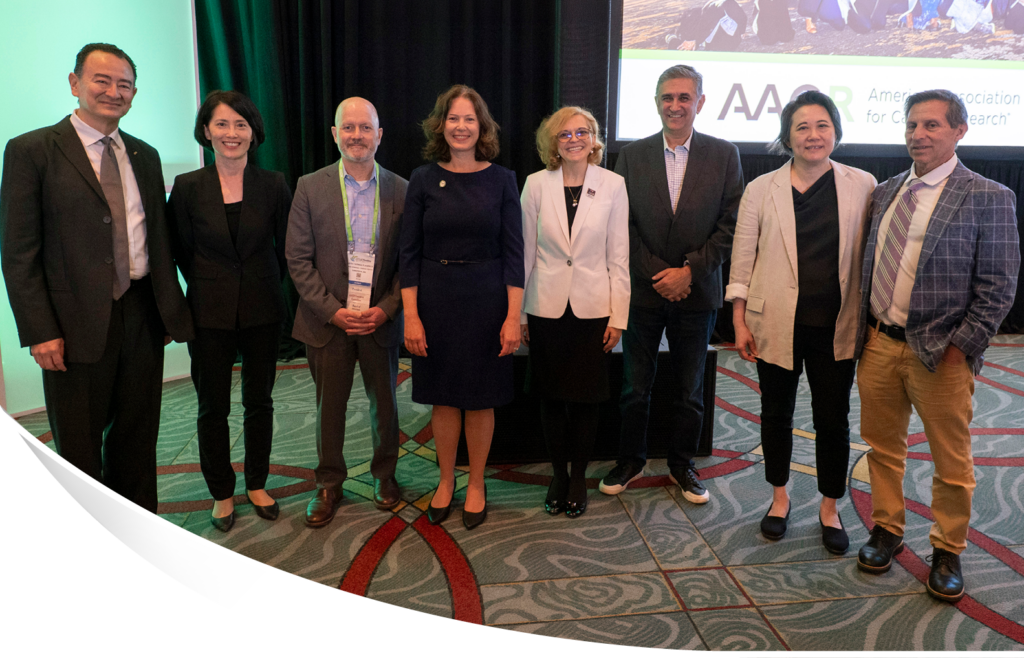

The second Clinical Trials Plenary Session at the AACR Annual Meeting 2026 featured an array of exciting updates from the world of antibody-drug conjugates (ADCs)—targeted therapies that use monoclonal antibodies to deliver drugs. Session Chair and Annual Meeting Clinical Trials Program Committee Cochair Ecaterina E. Dumbrava, MD, of The University of Texas MD Anderson Cancer Center, and Session Chair Manuel Hidalgo, MD, PhD, FAACR, of the New York University Langone Health Perlmutter Cancer Center, led the discussion as presenting scientists from around the world shared their work.
ADCs, Dumbrava said, “changed the shape of oncology,” even as the technology continues to develop quickly—an exciting prospect for the future of targeted therapies, she said.
Related Coverage:
- First Clinical Trials Plenary featured latest precision oncology therapies
- Third Clinical Trials Plenary Session delved into next-generation cellular therapies and immunotherapies
- Fourth Clinical Trials Plenary Session highlighted emerging developments in immunotherapy
Trastuzumab deruxtecan-olaparib combination treatment for HER2-positive cancers

Elizabeth K. Lee, MD, of Dana-Farber Cancer Institute, presented results from a phase I dose-escalation clinical trial that enrolled patients whose tumors, regardless of cancer type, expressed human epidermal growth factor receptor 2 (HER2). These patients were treated with a combination of the PARP inhibitor olaparib (Lynparza) and the ADC DS-8201a, also known as trastuzumab deruxtecan (Enhertu), which targets HER2-expressing cells.
Lee explained that her team’s study was premised on combining a PARP inhibitor with topoisomerase-inhibiting chemotherapy—a synergistic combination that, she said, had previously proven effective but intolerably toxic. According to Lee, DS-8201a offers potential targeted delivery of a topoisomerase payload in combination with PARP inhibitor therapy for a less toxic regimen.
Of the 28 enrolled and treated patients, 12 had uterine cancer and 16 had ovarian cancer, and all patients’ tumors were either recurrent or advanced, with most of those tumors having proven resistant to platinum-based chemotherapy. The patients were a heavily pretreated population, Lee said, and eligibility included a requirement for HER2-positive tumors.
Lee and colleagues assessed the efficacy and tolerability of dosing modules that used either continuous or intermittent olaparib in combination with doses of DS-8201a administered once every three weeks. Following an analysis of dose-limiting toxicities observed in several dose combinations, the team identified the recommended phase II dose as 5.4mg/kg of intravenous DS-8201a administered on day one of a 21-day cycle with 300 mg of olaparib administered twice a day on days 8-14.
This regimen demonstrated an acceptable safety profile. Some patients experienced low-grade pneumonitis, which was consisted with the expected toxicity of the two drugs, said Lee.
After a median follow-up of 8.44 months, the six-month progression-free survival (PFS) rate was 88.2%. The confirmed objective response rate (ORR) was 46%.
New EGFR-targeting ADC for advanced nasopharyngeal cancer

Xiugao Yang, MD, of CSPC Pharmaceutical Group Limited in China, delivered a talk about a new ADC being tested as a therapy for advanced nasopharyngeal carcinoma. The ADC, known as SYS6010, targets the protein EGFR, and its results in non-small cell lung cancer (NSCLC) were presented at the AACR Annual Meeting 2025.
Yang shared results from a phase I clinical trial that tested SYS6010 in patients with advanced nasopharyngeal carcinoma that had progressed after treatment with a first-line therapy—including PD1-inhibitor immunotherapy and platinum chemotherapy.
Yang reviewed safety data from 56 enrolled patients with a median age of 49.5, who received either 4.2 mg/kg (34 patients) or 4.8 mg/kg (22 patients) of intravenous SYS6010 every three weeks until disease progression or unacceptable toxicity. All patients experienced a treatment-emergent adverse effect (TEAE) of grade 1 or greater, and most patients (64.1%) experienced TEAEs of grade 3 or greater—the most common of which were hematological toxicities.
Among 54 patients who were evaluable for efficacy, 31.5% experienced objective response—including one complete response in the 4.2 mg/kg group—and the disease control rate (DCR) was 87%. The median PFS was 7.5 months, and after a median follow-up of 11.5 months, more than half of the participants were still alive.
Yang highlighted the fact that, for the subset of patients who had not received an EGFR-targeting monoclonal antibody before, the ORR was 42.9% for the 4.2 mg/kg dose group and 50% for the 4.8 mg/kg dose group. ORR and median PFS did not differ significantly between patients with high and low EGFR expression.
Treatment-resistant ovarian cancer responds to new CLDN6-targeting ADC

Tao Zhu, MD, of Zhejiang Cancer Hospital, China, presented phase I clinical trial data on a new ADC, QLS5132, which targets the protein CLDN6—a protein with preferential expression on ovarian cancer cells. The single-arm dose escalation trial enrolled 28 women (median age: 57.5) with advanced platinum-resistant ovarian cancer who had been heavily pretreated, and the patients received intravenous QLS5132 every three weeks in doses of either 1.6 mg/kg, 3.2 mg/kg, 4.8 mg/kg, 5.6 mg/kg, or 6.4 mg/kg.
TRAEs occurred in 26 of the 28 patients at all dose levels. Nine grade 3 or higher TRAEs were reported in total, seven of which were hematological toxicities. No TRAEs led to treatment discontinuation or death.
Among 18 evaluable patients, the ORR was 50% across all dose levels and 55.6% at the 4.8 mg/kg dose level. The DCR was 94.4% across all dose levels but 100% in patients who received a dose of 3.2 mg/kg or greater. Additionally, responses still occurred in patients with low or undetectable CLDN6 expression.
“The most encouraging finding from our study was that QLS5132 demonstrated compelling antitumor activity in patients with platinum-resistant ovarian cancer, with an objective response rate exceeding 50%,” Zhu said in a press release from the American Association for Cancer Research. “Equally important, at the potential recommended phase II dose, we observed a favorable safety profile with no reported cases of interstitial lung disease, ocular toxicity, oral mucositis, or febrile neutropenia.”
Risvutatug rezetecan with adebrelimab for nonsquamous, non-small cell lung cancer

Last up was Runbo Zhong, PhD, of Shanghai Chest Hospital in China, who shared results from the open-label, phase I ARTEMIS-101 clinical trial. The trial assessed the investigational ADC risvutatug rezetecan (ris-rez; also known as HS-20093 or GSK5764227) as a therapy for previously treated, advanced nonsquamous NSCLC that did not express targetable mutations. Ris-rez, which targets the immune checkpoint protein B7H3, was administered in combination with the investigational immune checkpoint inhibitor adebrelimab.
Zhong reported preliminary efficacy and safety results from a subgroup of one of the trial’s five cohorts. The subgroup comprised 40 patients with a median age of 64 who had received prior systemic treatment for nonsquamous NSCLC without actionable genomic alterations. These patients received 8 mg/kg of ris-rez and 20 mg/kg of adebrelimab in an intravenous infusion every three weeks.
All patients experienced treatment-related adverse events (TRAEs) of at least grade 1, and 28% of those were grade 3 or higher. The two most common grade 3 or higher TRAEs were decreased counts for white blood cells and neutrophils, both of which occurred in 30% of patients. No patients died of TEAEs or TRAEs.
After a median follow-up of 11.7 months, 34 patients were evaluable for efficacy. The confirmed ORR was 47.1%, the DCR was 94.1%, and the median PFS was 14 months.
The recording of the full session is available for registered Annual Meeting attendees through October 2026 on the virtual meeting platform.
More from the AACR Annual Meeting 2026 »
View a photo gallery of scenes from San Diego, join the conversation on social media using the hashtag #AACR26, and read more coverage in AACR Annual Meeting News and on Cancer Research Catalyst, the official blog of the AACR.