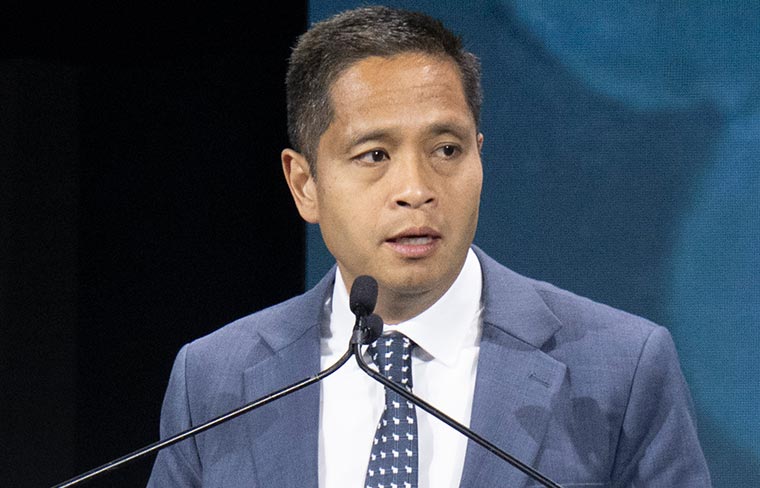
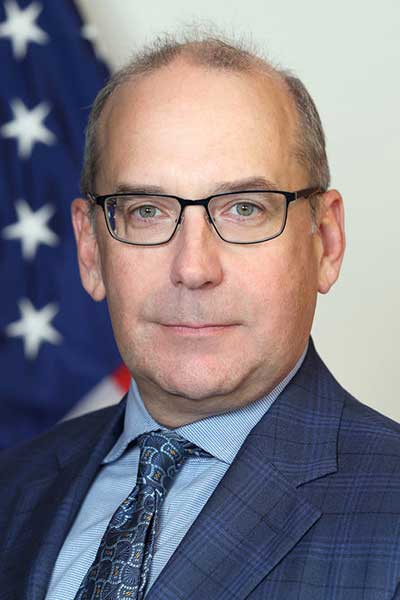
Anthony G. Letai, MD, PhD, FAACR, whose tenure as the director of the National Cancer Institute (NCI) began in September 2025, will share his vision for the agency at the AACR Annual Meeting 2026.
“We are looking forward to welcoming NCI Director Dr. Letai, who is expected to share with our Annual Meeting attendees that NCI has never been in a stronger position to advance its mission of reducing suffering from cancer,” said Jon Retzlaff, AACR’s chief policy officer. “He will also likely talk about some of his particular priorities, which includes immuno-oncology, cancer vaccines, functional precision medicine, artificial intelligence (AI), and ensuring that the United States maintains its lead over China in medical research.”
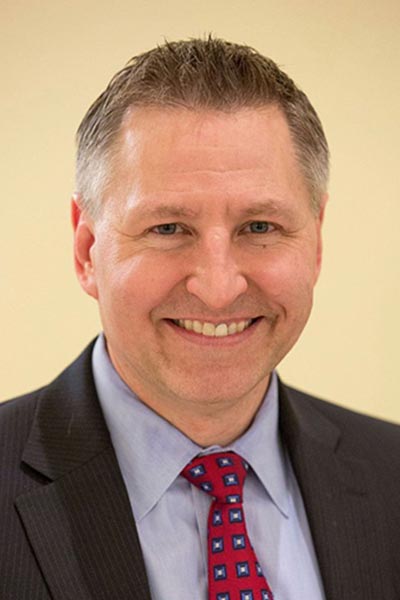
Letai’s address will take place on Monday, April 20, from 2:30 to 3:30 p.m. in Ballroom 6 A on the upper level of the San Diego Convention Center. The address will be followed by a fireside chat with AACR President Lillian L. Siu, MD, FAACR, of Princess Margaret Cancer Centre, University Health Network in Canada, and AACR President-Elect Keith T. Flaherty, MD, FAACR, of Massachusetts General Cancer Center and Harvard Medical School.
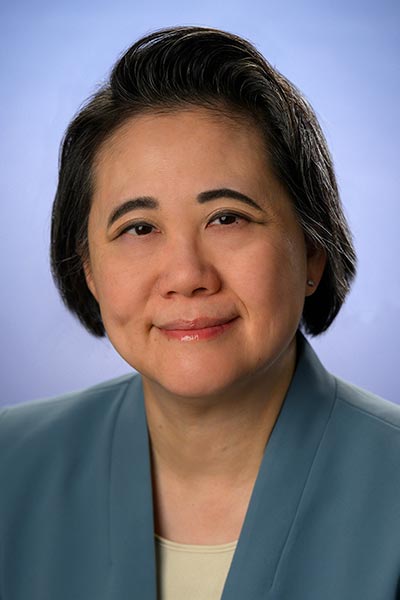
“Dr. Letai’s address is one of the most anticipated sessions of this year’s AACR Annual Meeting, generating strong interest across the cancer research community,” Siu said. “Dr. Flaherty and I look forward to our discussion with Dr. Letai following his remarks, which will offer an engaging opportunity to further explore his priorities for NCI.”
Beyond Letai’s address, representatives from the NCI and National Institutes of Health (NIH) will lead 10 other sessions at the Annual Meeting that will provide attendees with information about a number of funding opportunities and other resources that are available in various areas of cancer research, including cancer prevention and control, cancer biology, and AI and technology development, as well as opportunities for early-career cancer researchers.
Learn more about these sessions below, and refer to the Annual Meeting App and Online Itinerary Planner for the most up-to-date details. Recordings of all sessions will be available on-demand via the virtual meeting platform for registered attendees through the end of October.
NIH01: NCI Opportunities to Support Early Career Cancer Researchers and Research Specialists
Sunday, April 19, 1-2 p.m. PT
Room 2 – Upper Level – Convention Center
Moderator: Nastaran Zahir, PhD, National Cancer Institute
This session is designed for students, postdoctoral scholars, and scientists interested in NCI’s workforce development opportunities, highlighting NCI’s commitment to building training and career development pathways for skilled scholars to tackle problems in cancer research. In addition to funding cancer research across the nation, NCI also offers numerous fellowships available to conduct basic, clinical, or genomic and population-based research at one of the three NCI campuses in Maryland. Additionally, this session will cover the R50 program, which provides salary support for exceptional research specialists working in laboratories and core facilities, as well as clinician scientists contributing to NCI-funded clinical trials. Other funding opportunities that will be discussed include the upcoming ACE K32 career development award as well as NCI’s F30, F31, F99/K00, K01, K08, K25, K99/R00, and R50 mechanisms. The opportunities that will be highlighted for training at NCI will include Cancer Research Interns (CRI) Summer Program, Intramural Continuing Umbrella of Research Experiences (iCURE), and the Cancer Prevention Fellowship Program (CPFP).
NIH02: NCI Drug Development Resources and Grant Writing Strategies for New and Early-Stage Investigators
Sunday, April 19, 2:30-3:30 p.m. PT
Room 2 – Upper Level – Convention Center
Moderators: Sundar Venkatachalam, PhD, National Cancer Institute, and Christophe Marchand, PhD, National Cancer Institute
This NCI-sponsored session will focus on resources available to the extramural community for drug development research, funding opportunities, changes to the NIH review process, and grant writing strategies for new and early-stage investigators. Program staff from the Developmental Therapeutics Program/Division of Cancer Treatment and Diagnosis will provide an overview of research resources available for investigators, resources relating to grant writing strategies, requests for guidance from program staff, and information on the recently updated changes to the peer review process.
NIH03: NCI Opportunities in Technology Development for Cancer Research
Sunday, April 19, 4-5 p.m. PT
Room 2 – Upper Level – Convention Center
Moderator: Michelle A. Berny-Lang, PhD, National Cancer Institute
For decades, the NCI has invested in technology from early-stage, high-risk ideas to indispensable, widely adopted research tools. Two cornerstone programs provide sustained investment and strategic support that spans the entire technology lifecycle: Innovative Molecular Analysis Technologies (IMAT) and Informatics Technology for Cancer Research (ITCR). These programs have supported development of transformative technical capabilities and are catalyzing rapidly evolving areas of cancer research such as liquid biopsy techniques, spatial omics platforms, multidimensional microscopy systems, extrachromosomal DNA assays, and artificial intelligence. During this session, NCI program staff will discuss IMAT and ITCR funding opportunities and how they support technologies across their full lifecycle—from early development through maturation and long-term sustainment. For both programs, speakers will highlight unique features of the funding mechanisms and key considerations for prospective applicants. The session will also feature educational resources designed to enhance the usability and accessibility of informatics tools, so researchers can effectively apply computational approaches to their research questions.
NIH04: From Data Commons to Knowledge Engine: AI Enablement Across CRDC and CCDI
Monday, April 20, 10:15-11:15 a.m. PT
Room 2 – Upper Level – Convention Center
Moderator: Erika Kim, PhD, National Cancer Institute
The NCI Cancer Research Data Commons (CRDC) was established to create a scalable, interoperable ecosystem for sharing and analyzing multimodal cancer data across genomics, imaging, proteomics, clinical trials, and population-scale research. As the scale and heterogeneity of cancer data continue to expand, the primary challenge has shifted from data availability to semantic harmonization and knowledge extraction. To address these constraints on a national scale, NCI has partnered with ARPA-H’s Biomedical Data Fabric (BDF) Toolbox program to accelerate technologies focused on ontology-driven modeling, standardized metadata frameworks, semantic crosswalks, and AI-ready infrastructure. Within the CRDC ecosystem, BDF capabilities strengthen cross-commons interoperability by aligning data elements across genomic, imaging, and clinical domains; enabling construction of longitudinal, computable patient knowledge graphs; and supporting portable feature engineering pipelines for multimodal AI workflows. The Childhood Cancer Data Initiative (CCDI) exemplifies the impact of CRDC and BDF technologies. By contributing harmonized pediatric oncology datasets into CRDC, CCDI leverages BDF-enabled semantic frameworks to normalize diagnoses, treatments, biospecimens, and outcomes across institutions. Together, CRDC and BDF represent a strategic evolution in NCI’s national data strategy—from data aggregation toward structured knowledge generation. By prioritizing semantic alignment, ontology integration, and AI enablement, this framework strengthens standards-based data sharing while accelerating insight extraction across adult and pediatric cancer research.
NIH08: Modernizing Clinical Trial Communication: NCI’s AI-Enabled Toolkit for Research Protocols and Participant Materials
Monday, April 20, 12:30-1:30 p.m. PT
Room 2 – Upper Level – Convention Center
Moderator: Juli Klemm, PhD, National Cancer Institute
The NCI is modernizing clinical trial processes through an integrated suite of AI-enabled tools designed to reduce barriers to trial efficiency and equitable participant access. Developed within NCI’s Center for Biomedical Informatics and Information Technology (CBIIT), these tools leverage large language models to automate time-intensive document workflows, including informed consent generation, lay language trial summaries, and Spanish language translation, while maintaining regulatory compliance and scientific rigor. This session provides an opportunity for investigators, network partners, and research teams to learn directly from NCI staff about the initiative’s scope, practical applications, and implications for the broader cancer research community.
NIH06: Leveraging NCI-Supported Cancer Epidemiology Cohorts to Advance Cancer Prevention and Control
Monday, April 20, 4-5 p.m. PT
Room 2 – Upper Level – Convention Center
Co-chairs: Erin M. Siegel, PhD, MPH, National Cancer Institute, and Iona C. Cheng, PhD, MPH, University of California, San Francisco
Cancer epidemiology cohorts play a critical role in advancing cancer control and prevention, generating transformative insights that inform interventions and strategies to reduce cancer incidence, morbidity, and mortality in humans. This session will highlight selected NCI-funded cohorts—both established and newly developed—and their roles in fostering innovative research, ancillary studies, and collaborative opportunities, including pathways for junior investigators. A multidisciplinary panel will discuss strategies to enhance cohort sustainability and impact, including data harmonization, infrastructure modernization, AI integration, and community engagement to strengthen recruitment, retention, and responsible data sharing.
NIH07: NCI/NIH Consortia Initiative: Metabolic Dysregulation and Cancer Risk Program: A Transdisciplinary Approach to Obesity-Associated Cancers
Tuesday, April 21, 10:15-11:15 a.m. PT
Room 2 – Upper Level – Convention Center
Co-chairs: Edward Richard Sauter, MD, PhD, National Cancer Institute, Anil Wali, PhD, National Cancer Institute, and Wanping Xu, PhD, National Cancer Institute
Obesity is a pressing public health crisis, with over 70% of Americans classified as overweight or obese. The condition is linked to more than 13 cancer types, underscoring a significant challenge for cancer prevention and control. To address these complexities, the NCI established the Metabolic Dysregulation and Cancer Risk Program (MeDOC), a trans-NCI initiative aimed at advancing understanding of how obesity-induced metabolic dysregulation drives cancer risk. The MeDOC initiative promotes scientific innovation and synergy through its structure, which includes five U01 research projects and a Coordinating Center. This session will provide an overview of the programmatic framework of the MeDOC consortium, emphasizing the structure and scientific investigations, collaborative efforts, and resources available through the consortium. By showcasing the initiative’s strategic integration of research and resource-sharing, the session aims to highlight how NCI is leveraging its funding and collaborative frameworks to address the critical intersection of obesity, metabolic dysregulation, and cancer risk. This programmatic focus will inform the extramural community about opportunities to engage with and contribute to our understanding of obesity-associated cancers.
NIH05: FLAIMME: A National Federated Learning Consortium Advancing Privacy-Preserving Oncology AI Through Foundation Model Adaptation
Tuesday, April 21, 12:30-1:30 p.m. PT
Room 2 – Upper Level – Convention Center
Moderator: Juli Klemm, PhD, National Cancer Institute
Cancer AI research conducted across NCI-designated cancer centers is increasingly supported by the NCI’s CBIIT. This session provides an opportunity for oncology researchers, informaticists, and institutional leaders to learn about and engage directly with FLAIMME (Federated Learning-based AI in Multi Modal Exploration)—an NCI-supported consortium enabling privacy-preserving, multi-institutional AI model development without centralizing patient data. Topics to be covered include the FLAIMME consortium’s infrastructure and governance model, federated foundation model adaptation using MedGemma for cancer-relevant tasks such as clinical trial matching and treatment response prediction, and traditional federated learning approaches applied to cancers including glioblastoma. CBIIT staff will provide interactive presentations highlighting how FLAIMME lowers barriers to collaborative oncology AI development for institutions of varying sizes and computational capacity.
NIH09: NCI/NIH Opportunities in Funding: NCI-Cancer Diagnosis Program Initiatives and Biospecimen Resources for Investigators
Tuesday, April 21, 2:30-3:30 p.m. PT
Room 2 – Upper Level – Convention Center
Moderator: Aniruddha Ganguly, PhD, National Cancer Institute
The Cancer Diagnosis Program (CDP) strives to improve diagnosis and assessment of cancer by effectively moving new scientific knowledge into clinical practice. CDP stimulates, coordinates, and funds research and resources for the development of innovative in vitro diagnostics, novel diagnostic technologies, and appropriate human specimens to better characterize cancers and allow improved medical decision-making and evaluation of response to treatment. This session will provide an overview of initiatives that address important research areas in cancer diagnostics to advance biomarkers and technological tools for research and clinical decision-making. Additionally, this session will provide an overview of biospecimen resources including the Cooperative Human Tissue Network (CHTN) and NCI-National Clinical Trials Network (NCTN) and Cancer Moonshot Biospecimen Banks.
NIH10: NCI Funding of Extramural Cancer Biology Research
Tuesday, April 21, 4-5 p.m. PT
Room 2 – Upper Level – Convention Center
Moderator: Daniel L. Gallahan, PhD, National Cancer Institute
Cancer biology research conducted by attendees of the AACR Annual Meeting is frequently supported by the NCI’s Division of Cancer Biology (DCB). This session provides an opportunity for early-stage and established investigators to interact directly with NCI staff, including the DCB Director Dan Gallahan, PhD. Topics to be covered include the NCI grants system, communicating with a program director, funding opportunities and highlighted topics, data management and sharing, and information about NCI extramural research. DCB staff will provide interactive presentations to update basic and translational researchers about the work of the division.
More from the AACR Annual Meeting 2026 »
View a photo gallery of scenes from San Diego, join the conversation on social media using the hashtag #AACR26, and read more coverage in AACR Annual Meeting News and on Cancer Research Catalyst, the official blog of the AACR.