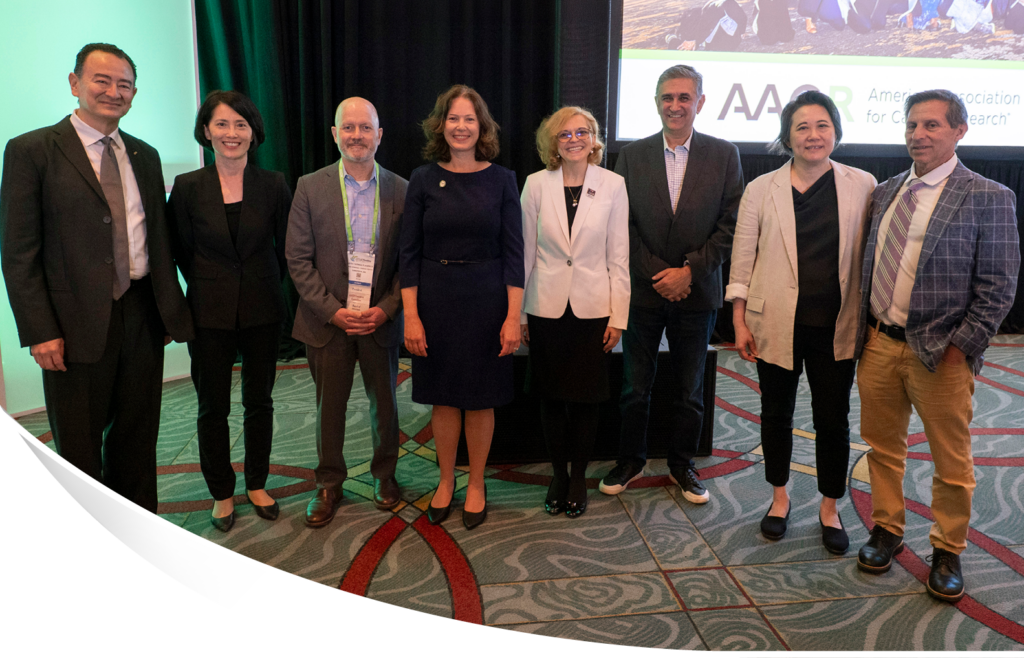
A Special Session jointly organized by the American Association for Cancer Research (AACR) and the Japanese Cancer Association (JCA) will examine some of the crucial questions surrounding the development of lung cancer in never-smokers and why this is such an urgent area for research.
The “AACR-JCA Joint Session: Lung Cancer in Never-Smokers” is co-chaired by Maria Teresa Landi, MD, PhD, of the National Cancer Institute, part of the U.S. National Institutes of Health, and Takashi Kohno, PhD, of National Cancer Center in Japan, and will address the topic from multiple perspectives, including molecular epidemiology, basic biology, and clinical research. The session will also explore why this cancer, especially the epidermal growth factor receptor (EGFR)-mutant lung adenocarcinoma subtype, is more prevalent among individuals of Asian descent.
“It has long been recognized that the incidence of lung cancer among never-smokers is higher in Asian populations than in Western populations,” said Kohno. “In particular, EGFR-mutant lung adenocarcinoma, which in Western countries occurs predominantly in never-smokers, is observed at relatively high frequency in Japan among both smokers and never-smokers. In my presentation, ‘Unraveling the genetic and environmental risk factors for lung adenocarcinoma in Asia,’ I will focus on lung adenocarcinoma in the Japanese population and discuss possible mechanisms of carcinogenesis and risk factors by examining both somatic and germline genetic alterations. I hope this will stimulate further discussions on how lung cancer develops in never-smokers.”
The session will include discussions by Jaclyn LoPiccolo, MD, PhD, of Dana-Farber Cancer Institute, on “Germline variation in oncogene-driven, young-onset, and familial lung cancer,” and Se-Hoon Lee, MD, PhD, of Samsung Medical Center in South Korea, on “Differential response to anticancer treatment depending on smoking status in lung cancer.”
“Dr. LoPiccolo’s presentation is a particularly exciting topic because while germline susceptibility is frequently discussed in such cancers as breast and colorectal, it is still relatively uncommon to explore these aspects in lung cancer,” said Kohno. “As a leading clinical investigator in Asia, Dr. Lee’s insights into differences in treatment responses between smokers and never-smokers with lung cancer will be especially valuable. His presentation is also expected to provide important implications for the design of future clinical trials in Asia.”
To close out the session, Landi will lead a discussion titled “Sherlock-Lung: Charting the landscape of lung cancer in never-smokers,” which will focus on large-scale genomic data comparing lung cancer in never-smokers vs. lung cancer in smokers.
“Based on our findings, along with evidence from animal models, I will propose a hypothesis that may help address some of the open questions surrounding the development of lung cancer in never-smokers,” said Landi.
Although some reports claim that lung cancer in never-smokers is on the rise, Landi cautions that it’s impossible to determine whether the incidence of the disease among never-smokers is actually increasing because most major cancer registries do not collect information on tobacco smoking exposure. It may appear more common as the rate of smoking continues to decline.
“The AACR-JCA Joint Session: Lung Cancer in Never-Smokers is unique in that it focuses specifically on lung cancer that occurs independently of smoking,” the chairs said. “It will be informative for a wide range of researchers in academia working on cancer prevention, early detection, carcinogenesis, and clinical research. It will also be valuable for academic and industry researchers conducting clinical trials involving Asian populations. In addition, researchers studying other cancer types may find the discussion insightful.”
Promoting an exchange of scientific ideas
The collaborative effort between AACR and JCA to bring together the scientific exchange of ideas from researchers in Asia and the United States has a long history, dating back to 1989 when the two organizations held their first joint conference in Hawaii. They have since held multiple meetings in Japan, and, each year, the two hold joint symposia at their respective Annual Meetings.
“This collaboration not only promotes scientific exchange, it also fosters personal connections between researchers from Japan and other countries worldwide,” said Kohno. “Many Japanese scientists have subsequently pursued cancer research in U.S. institutions as a result of these interactions. Discussions at these meetings have also facilitated the exchange of ideas about cancers that are more prevalent in Asian populations and about complementary research strengths, contributing to the generation of new scientific insights.”
The Special Session “AACR-JCA Joint Session: Lung Cancer in Never-Smokers” will be held on April 20, from 2:30 to 4:30 p.m. PT, in Ballroom 6 DE on the upper level of the San Diego Convention Center.
For the most up-to-date information on session dates, times, and locations, check the Annual Meeting App and Online Itinerary Planner.
More from the AACR Annual Meeting 2026 »
View a photo gallery of scenes from San Diego, join the conversation on social media using the hashtag #AACR26, and read more coverage in AACR Annual Meeting News and on Cancer Research Catalyst, the official blog of the AACR.