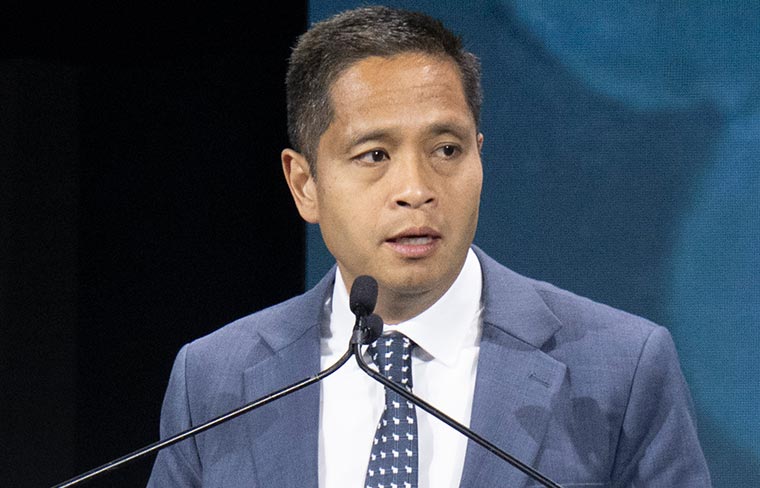
At the AACR Annual Meeting 2026, National Cancer Institute (NCI) Director Anthony Letai, MD, PhD, FAACR, shared his vision and priorities for NCI, while also addressing some of the concerns around funding opportunities he has heard from the cancer research community.
“I want to acknowledge that for many of you, the past year has felt very turbulent,” Letai said. “I want to tell you one thing very clearly: The NCI is stable, our mission remains unchanged, and funding is strong.”
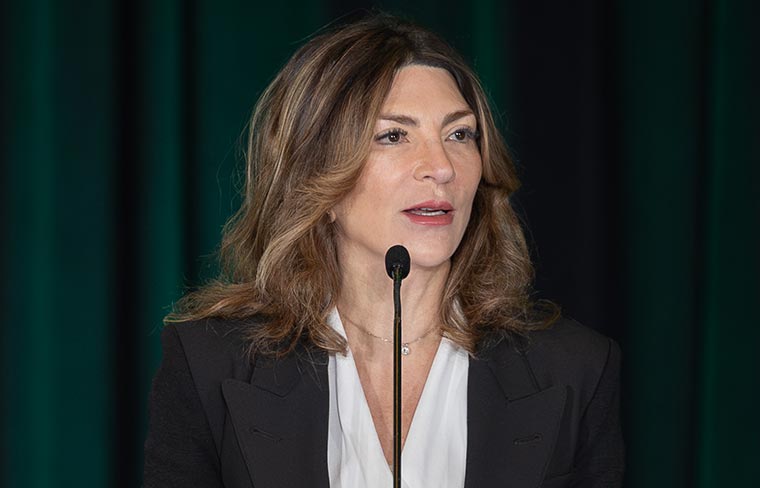
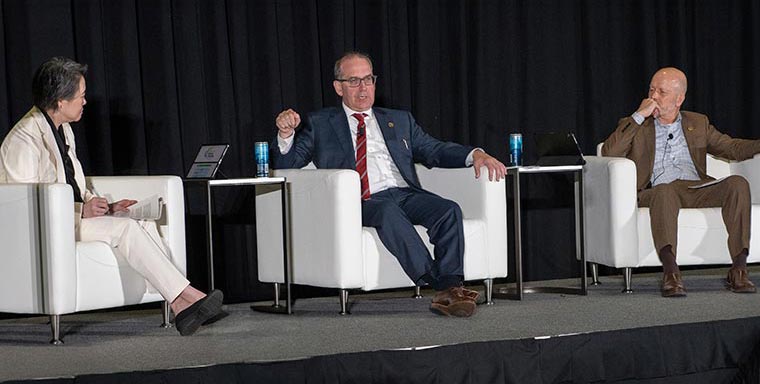
Over the course of his address and fireside chat with AACR Immediate Past President Lillian L. Siu, MD, FAACR, and AACR President Keith T. Flaherty, MD, FAACR, Letai addressed the scientific community’s concerns around some of the changes being made in how the NCI operates. He explained that NCI has adopted a new unified funding strategy that no longer uses a strict payline to determine which grants get funded. Instead, they will use a select pay structure, in which decisions are made on a case-by-case basis.
In the past, a select pay structure was used to make decisions for about 15% of NCI’s portfolio but now it will be used for all grants. During this process, grant proposals will be evaluated on aspects such as their alignment with the mission of the National Institutes of Health (NIH), including projects related to NIH and NCI highlighted topics; ensuring balance across NCI’s scientific portfolio as well as geographically across the United States; and investigators’ career stage, with a particular interest in supporting early-career investigators.
“Let me be extremely clear about this: Peer review and scientific merit remain the most important factors in determining whether a grant is funded or not,” Letai said.
He also addressed concerns over multiyear funding, in which five-year grants are awarded funds for multiple years upfront instead of each year. He admitted the increase in multiyear funding resulted in fewer grants being awarded overall in fiscal year 2025 but indicated this will not be a wholesale shift and the proportion of multiyear funding should remain stagnant in fiscal year 2026. In 2025, he said, multiyear funding reflected about $480 million of the $5.5 billion that NCI provided for extramural research. However, he said NCI would like to use a similar structure to help support high-risk, high-reward science, where they fund the first two years of a project and then conduct an administrative review to determine if the project should continue.
“This lets us support ideas that might not have been funded under a traditional five-year model,” Letai explained.
On the topic of animal models, he said NCI is not forbidding animal research, but researchers will be expected to provide an explicit justification for the necessity of animal studies in their proposals. Overall, he explained NIH and NCI are prioritizing research that is more directly related to human biology and encouraged researchers to explore the use of human-based New Approach Methodologies (NAMs), if applicable to their work.
Additionally, Letai shared some of the areas he considers to be particularly important for NCI moving forward, including increasing the speed and efficiency in getting early-phase clinical trials off the ground in the United States, continuing to provide support for early-career investigators, exploring advances in functional precision medicine and cancer vaccines, improving how NCI communicates with the public, and increasing access to cancer prevention, screening, and early detection methods to underserved areas.
The session recording is available for registered Annual Meeting attendees through October 2026 on the virtual meeting platform.
More from the AACR Annual Meeting 2026 »
View a photo gallery of scenes from San Diego, join the conversation on social media using the hashtag #AACR26, and read more coverage in AACR Annual Meeting News and on Cancer Research Catalyst, the official blog of the AACR.