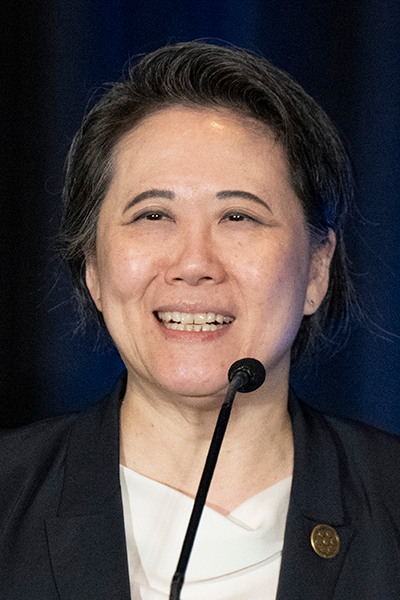
Over the course of her three-plus decade career, Lillian L. Siu, MD, FAACR, has seen how research into head and neck cancer can serve as a discovery engine capable of deriving insights that can be generalized across solid tumors. So, for her Presidential Address at the AACR Annual Meeting 2026, she laid out how new discoveries about the molecular landscape of head and neck cancer could potentially be applied across cancer types.
Throughout her career—including her current roles as senior medical oncologist and co-director of the Phase I Clinical Trials Program at the Princess Margaret Cancer Centre, University Health Network in Canada—Siu has mostly dealt with advanced stages of head of neck cancer when patients have already exhausted their options and have very resistant cancer. But some of her more recent work has been focused on finding opportunities to eradicate this cancer in earlier stages, including by examining the ability to detect the trace amounts of cancer left behind after treatment, known as molecular residual disease or minimal residual disease (MRD).
Siu explained how, until recently, traces of cancer could only be seen using imaging (CT or MRI scans) or by screening for various protein biomarkers; however, advances in technology have led to ultrasensitive assays capable of identifying MRD through circulating tumor DNA (ctDNA) in the blood. Since these minute quantities of cancer can drive recurrence, the ability to detect MRD provides the opportunity to intercept the cancer before it grows and spreads, Siu explained. This approach has been used for decades in hematological malignancies, but progress is being made in doing the same for solid tumors—including by Siu’s team.
Monitoring for MRD to intercept recurrence
After first determining the feasibility of detecting MRD in head and neck cancer, Siu and her colleagues launched the MERIDIAN phase II trial. The trial was designed to monitor patients with high-risk locoregionally advanced head and neck squamous cell carcinoma following definitive treatment. If MRD was detected, patients would be randomly assigned (3:1) to either receive treatment with the investigational bispecific antibody rilvegostomig or to go into the observation arm.
The initial goal was to enroll 200 patients, but Siu and her team stopped after 50 patients to check their status. Of the 50 patients, 42 were evaluable, and five of them had positive ctDNA results indicating MRD, and one had equivocal ctDNA, meaning the presence of MRD was uncertain. After further screening, two were confirmed to have MRD and were moved into the interception part of the trial. The patient who was randomly assigned to receive rilvegostomig has now been disease-free for 22 months, Siu said.
“Clearly, we have seen the hint that … we are able to intercept this disease,” Siu said. “If we are able to catch more of these cancers [earlier], we are possibly able to change the outcome of these patients.”
Given this proof of concept, Siu said they amended the trial protocol to adapt a newer, more sensitive assay that may better detect MRD and have recently re-opened the trial for the next 50 patients. Additionally, they also received funding to launch a much larger trial: SHERLOCK (Study of High-Precision Evaluation of Molecular ResiduaL Disease through a PlatfOrm for Cancer TracKing and Interception). The goal is to create the world’s largest MRD pancancer cohort by enrolling approximately 7,000 patients over four years. In addition to an interception arm, this trial will also have an arm for treatment de-escalation, where patients who test negative for MRD may receive less toxic or shorter treatments.
Exploring dynamic biomarkers for treatment response
Siu then transitioned to another aspect of her work she believes could transcend tumor types—dynamic biomarkers. For example, in the IO-KIN trial, they studied the kinetics of ctDNA after patients with recurrent or metastatic head and neck cancer received an immune checkpoint inhibitor. One of the aspects that Siu found most interesting was how patients with a downward trend in ctDNA kinetics—meaning they are responding to treatment—also have a much more diversified and richer T-cell receptor (TCR) repertoire. Siu explained how this has potential to be used to provide real-time signals of treatment benefit.
Siu also touched on the promise of using spatial transcriptomics to predict immunotherapy outcomes across cancers. To better understand what is really happening in the tumor microenvironment at a cellular level, one member of Siu’s team took a deep dive into the spatial transcriptomics of patients with head and neck cancer receiving an immune checkpoint inhibitor. After looking at tens of thousands of malignant and non-malignant spots, they were able to identify signatures associated with treatment response and clinical outcome. From there, they wanted to verify these signatures using bulk transcriptomics across multiple tumor types and ultimately found there is a hint they could translate to a pancancer context.
Siu and her team will further examine the validity of some of these biomarkers—including the spatial transcriptomics signature and TCR repertoire—in the newly launched BeeHive study evaluating an anti-B7H3 antibody drug conjugate in patients with recurrent metastatic head and neck squamous cell carcinoma.
Again, Siu hopes what they learn from this trial can be extrapolated to other cancers and lead to more opportunities to improve the treatment of patients.
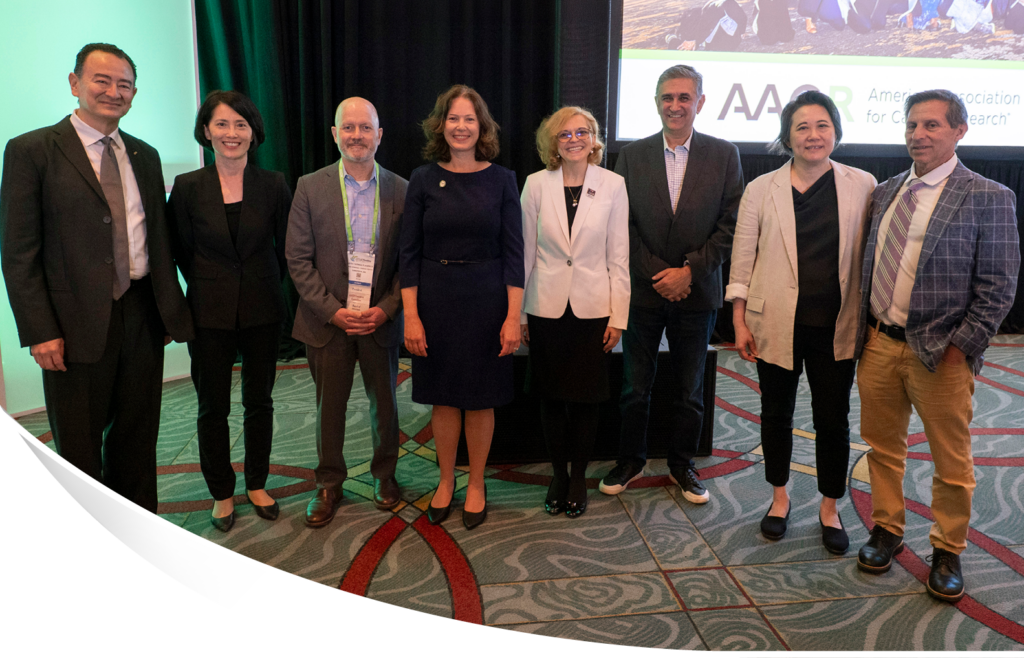
As Siu has started to treat earlier stages of cancer, she has become more intrigued by precision medicine-driven approaches to prevent cancer, which served as the topic of her Presidential Select Symposium. She assembled a panel of experts who discussed screening newborns for cancer predisposition genes, identifying interventions for people with Lynch syndrome, preventive cancer vaccines, and the use of artificial intelligence to help detect and diagnosis cancer. Learn more about this session on Cancer Research Catalyst, the official blog of the AACR.
The recording of each session is available for registered Annual Meeting attendees through October 2026 on the virtual meeting platform.

More from the AACR Annual Meeting 2026 »
View a photo gallery of scenes from San Diego, join the conversation on social media using the hashtag #AACR26, and read more coverage in AACR Annual Meeting News and on Cancer Research Catalyst, the official blog of the AACR.