

The New Drugs on the Horizon: Part 3 session wrapped up the New Drugs on the Horizon series at the AACR Annual Meeting 2026 with descriptions of a first-in-class inhibitor of cyclin A/B-substrate interaction, a molecular glue degrader for the treatment of acute myeloid leukemia (AML), a novel antibody-drug conjugate (ADC), and a dual T-cell agonist selective for a specific T-cell subtype.
Introducing the session, Co-chair Katrina L. Jackson, PhD, of C4 Therapeutics, said that New Drugs on the Horizon, sponsored by the AACR Chemistry in Cancer Working Group, is a flagship series known for being a premier global stage for first disclosures of next-generation therapeutics.
Related Coverage
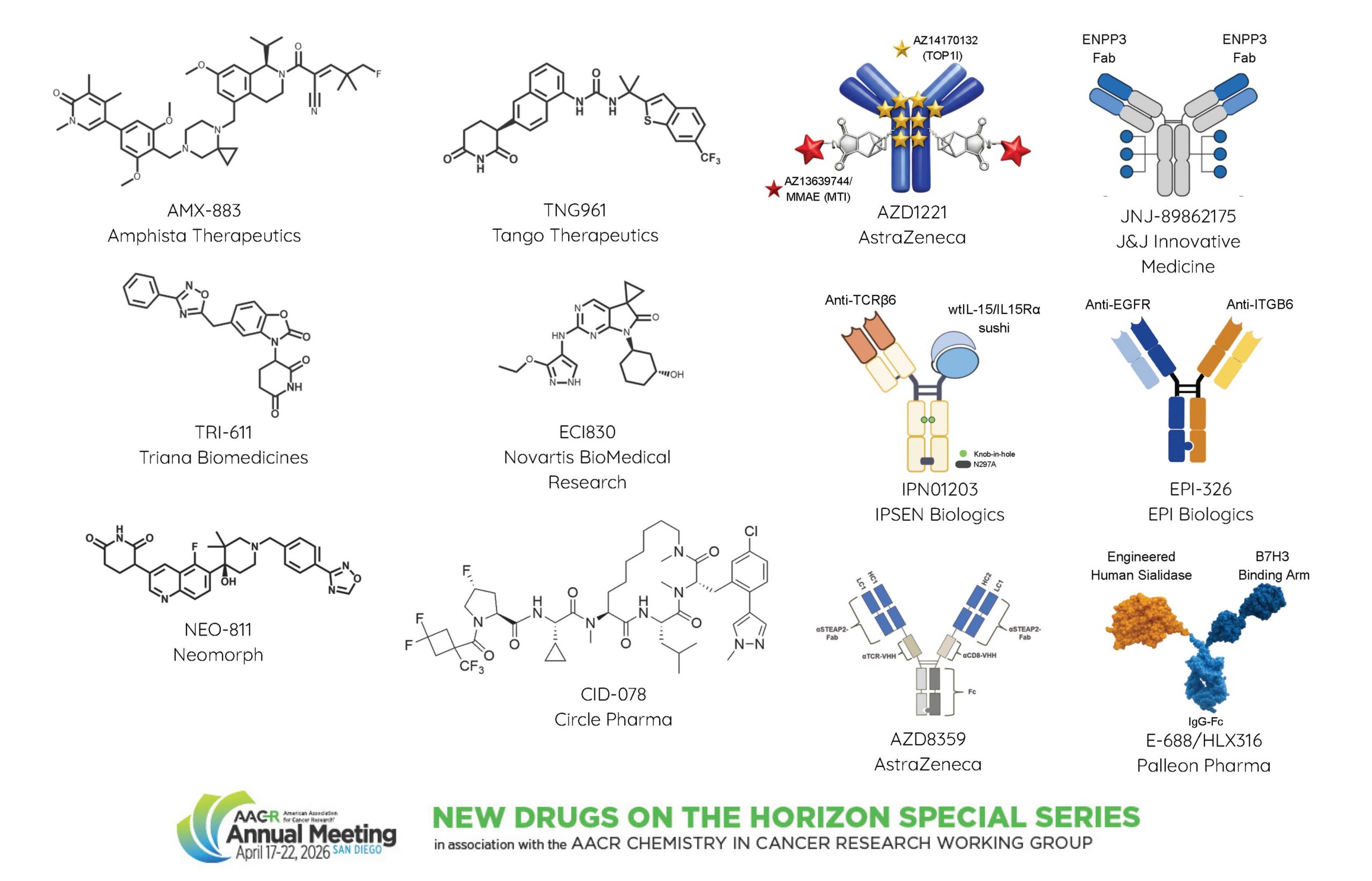
Marie Evangelista, PhD, of Circle Pharma, Inc., discussed the discovery of CID-078, a first-in-class oral macrocycle cyclin A/B-RxL inhibitor.

While several cyclin-dependent kinase inhibitors have been approved or are in development, cyclins have proven challenging to target. Evangelista and team developed a platform to discover a potent, cell-permeable, oral macrocycle that mimics the RxL domain present in cyclin substrates to inhibit the interaction of cyclin A and cyclin B with their binding partners.
Through inhibition of cyclin A and cyclin B function, CID-078 treatment caused tumor cell death by inducing replication stress and DNA damage and then by forcing damaged cells into mitosis. Importantly, tumor cell lines and xenograft models with elevated E2F pathway activity, including those with RB1 loss, displayed increased sensitivity to CID-078.
A phase I trial of CID-078 in solid tumors is currently enrolling patients. Early results from this study were presented during Clinical Trials Plenary Session 1: “New Frontiers in Precision Oncology.”

Martin Pass, PhD, of Amphista Therapeutics, highlighted AMX-883, a highly selective molecular glue degrader that causes degradation of BRD9, which is involved in maintaining the differentiation block that prevents normal myeloid maturation in AML cells.
In vitro studies confirmed that AMX-833 treatment resulted in BRD9 degradation and differentiation across multiple AML cell lines. In patient-derived xenograft models, AMX-883 significantly reduced leukemic burden and increased survival. Furthermore, AMX-833 synergized with venetoclax (Venclexta) in vitro and in vivo.
Clinical evaluation of AMX-833 is planned to begin in 2026.
Smruthi Vijayaraghavan, PhD, of Johnson & Johnson Innovative Medicine, described the discovery and preclinical characterization of JNJ-89862175, a novel ADC targeting the ENPP3 protein.

ADCs are a clinically validated therapeutic modality in solid tumors, said Vijayaraghavan, but researchers now face the challenge of identifying novel protein targets that are not expressed in normal tissues. ENPP3 represents a suitable candidate because it is a transmembrane protein with apically restricted expression in normal tissue and depolarized expression in tumors and it is broadly overexpressed in multiple solid tumors. JNJ-89862175 is a bivalent antibody with high affinity and specificity for ENPP3 conjugated to a microtubule inhibitor payload.
JNJ-89862175 specifically bound to ENPP3, underwent rapid internalization, and exerted cytotoxicity in vitro. In patient-derived xenograft models, JNJ-89862175 treatment demonstrated strong antitumor activity following a single-dose administration. JNJ-89862175 was well tolerated in preclinical toxicity studies.
JNJ-89862175 is currently being evaluated in a phase I clinical trial in patients with ENPP3-expressing advanced solid tumors.

Stephan G. Klinz, PhD, of Ipsen Bioscience, Inc., introduced IPN01203, a bispecific T-cell agonist designed to activate Vβ6/Vβ10-expressing T cells, which are enriched in tumor-infiltrating lymphocytes. Klinz illustrated how next-generation bispecific T-cell activators may help overcome some of the limitations of current immunotherapies by selectively expanding tumor-specific CD8- and CD4-positive T-cell subsets.
IPN01203 treatment led to preferential activation of Vβ6/ Vβ10-positive T cells, expansion of clones with a central memory phenotype, and IFNɣ signaling. It also potently inhibited tumor growth and improved survival in mouse models, increasing intratumoral T-cell clonal diversity. In non-human primate models, IPN01203 had an acceptable safety profile with minimal cytokine release.
Early clinical evaluation of IPN01203 is underway in a phase I trial.
The recording of the full session is available on demand for registered Annual Meeting attendees through October 2026 via the virtual meeting platform.

More from the AACR Annual Meeting 2026 »
View a photo gallery of scenes from San Diego, join the conversation on social media using the hashtag #AACR26, and read more coverage in AACR Annual Meeting News and on Cancer Research Catalyst, the official blog of the AACR.